
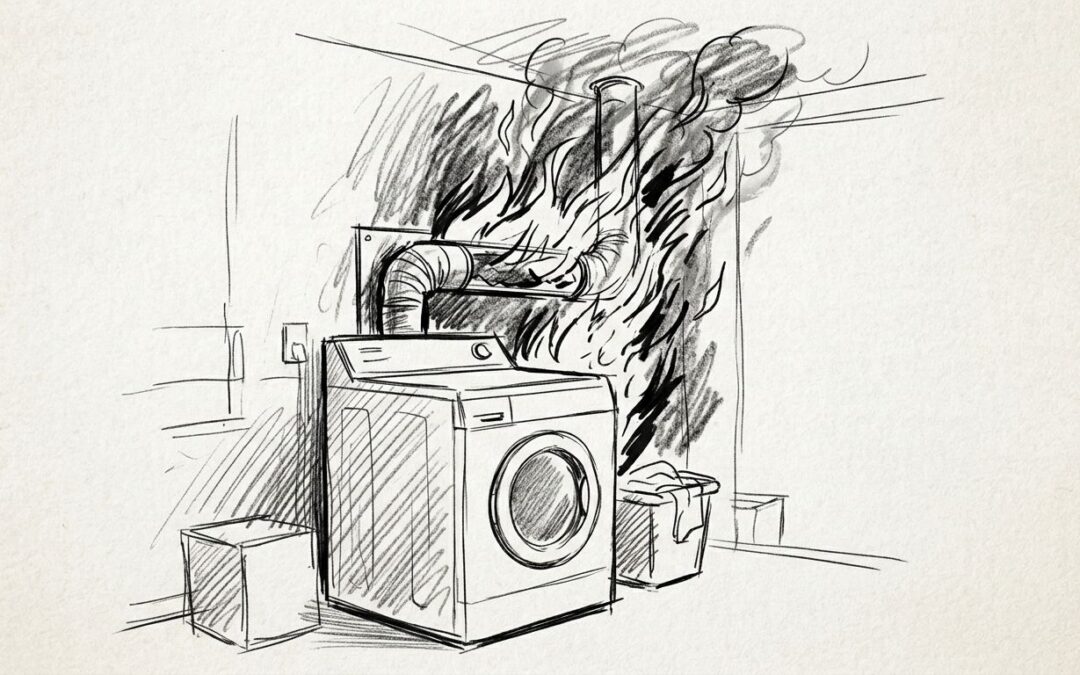
The U.S. Fire Administration estimates 2,900 residential clothes dryer fires per year in the United States, but that figure does not show how many fires dryer vents specifically cause. Failure to clean was a contributing factor in 34% of the dryer fires in its analysis. These figures come from an earlier study, not a count of fires in 2026.
- A clothes dryer fire is not necessarily a dryer vent fire: the U.S. Fire Administration estimates 2,900 residential dryer fires yearly, not vent-only fires.
- Failure to clean contributed to 34% of dryer fires in the U.S. Fire Administration’s analysis; the figure does not isolate vent blockages.
- Clean the lint screen for every load and the exhaust duct every 3 months, following U.S. Fire Administration guidance.
- Dundas Jafine dryer venting products are relevant when specifying an exhaust path, but no vent product replaces regular cleaning.
Why this matters
A blocked exhaust path can leave lint where it does not belong and restrict the air leaving your dryer. The practical question is not whether every dryer fire begins in a vent; it is whether your entire exhaust path is clear, correctly installed and maintained.
That path matters when an installation is changed, not just when lint is removed. If you are considering a shared exhaust route, address the separate installation question in can you vent two dryers into one exhaust duct? before connecting equipment. In 2026, use your dryer’s installation instructions and applicable local requirements to decide how the exhaust must be routed.
How often do dryer vents cause house fires?
There is no vent-only national figure in the cited U.S. Fire Administration estimate. Its published analysis concerns fires involving residential clothes dryers. It identifies failure to clean as a leading contributing factor, but it does not assign all such fires to a particular part of the exhaust system.
| What the U.S. Fire Administration reports | Figure | What you can conclude |
|---|---|---|
| Residential clothes dryer fires in the United States | 2,900 per year | This is an estimate for dryer fires, not dryer-vent fires. |
| Dryer fires in which failure to clean was a contributing factor | 34% | Cleaning matters; the figure does not identify which component needed cleaning. |
| Fires caused specifically by dryer vents | No separate figure in this estimate | Do not describe all 2,900 fires as vent-caused. |
The distinction changes how you act on the data. A clean lint screen does not establish that the exhaust duct and outdoor opening are clear. Conversely, a blocked vent should be corrected even though the national estimate cannot tell you precisely how many fires began there.
The 2,900-per-year figure is an estimate from an earlier U.S. Fire Administration analysis. It is not a measured 2026 total, and it does not describe Canadian fire incidence. For a homeowner or installer in either country, the immediate task is to inspect the specific dryer and exhaust route in front of you.
What does failure to clean include?
Failure to clean is broader than a dirty exterior vent. Lint can remain at the screen, inside the dryer or along the exhaust path. The U.S. Fire Administration’s 34% figure identifies a contributing factor in dryer fires; it does not say that the exterior vent caused 34% of them.
Inspect the system as connected parts:
- Lint screen: Remove accumulated lint for every load. Do not operate the dryer without its lint screen.
- Connection behind the dryer: Check whether the exhaust duct has been crushed or disconnected, particularly after moving the appliance.
- Exhaust duct: Arrange to remove lint from the full duct path, not just the section you can see from the laundry room.
- Outdoor opening: Check that the outlet is unobstructed and opens while the dryer operates.
- Dryer interior: If drying takes longer than normal after accessible parts are cleaned, arrange an inspection rather than assuming the exterior opening is the only problem.
These checks address different locations. Clearing one does not prove that the others are clear. If you cannot safely access the duct or determine where a restriction sits, use a qualified service professional.
How do you reduce dryer vent fire risk?
Follow a maintenance sequence that covers the entire exhaust route. In 2026, the U.S. Fire Administration’s published advice remains a clear baseline: clean the lint screen for every load and clean lint from the vent pipe every 3 months. Your dryer’s instructions and local installation requirements govern the equipment you actually have.
- Clean the lint screen. Remove lint for every load and confirm that the screen is in place before operating the dryer. This is the frequent task; it does not replace duct cleaning.
- Inspect the outside vent. While the dryer runs, check that the outdoor opening is not obstructed and that its flap opens. Keep hands clear of moving parts and follow the appliance instructions.
- Clear the exhaust duct. Follow the U.S. Fire Administration’s every-3-months guidance for removing lint from the vent pipe. Arrange professional cleaning when the route is inaccessible or you cannot confirm it is clear.
- Check the installation. Look for a crushed connection behind the dryer and confirm the exhaust arrangement follows the dryer manufacturer’s instructions. Correct an installation problem rather than relying on more frequent lint removal to offset it.
- Respond to warning signs. If loads take longer than normal to dry, stop treating repeated cycles as routine. Check the lint screen and accessible exhaust openings, then have the system inspected if the problem remains.
Dundas Jafine dryer venting products are best for homeowners and installers specifying a suitable exhaust path; they are not a substitute for cleaning that path. Select components only after checking the dryer instructions and applicable requirements. Product choice, installation and maintenance each address a different part of the problem.
Review your venting options
Explore Dundas Jafine air distribution and venting products.
Why dryer fire risk varies
The national estimate describes a group of incidents, not the condition of your home’s vent. These factors determine what deserves attention during an inspection:
- Lint left in multiple places. Cleaning the screen does not remove lint already inside the duct or dryer.
- A restricted outdoor opening. An obstruction at the termination prevents exhaust from leaving as intended, even if the connection behind the dryer looks clear.
- A crushed or disconnected duct. Moving the dryer can change a connection that previously appeared sound.
- An exhaust route you cannot inspect. If you cannot see or reach the full route, arrange cleaning or inspection rather than declaring it clear from one visible section.
- Installation that conflicts with instructions. Use the dryer manufacturer’s directions and the requirements that apply where you live; a replacement component alone does not correct an unsuitable route.
- Drying time that changes. Longer-than-normal drying is a reason to check the dryer and exhaust system, not proof of a particular blockage location.
No single sign establishes that a vent is safe. A clear-looking outdoor opening cannot show the condition of the duct behind a wall, and a recently cleaned lint screen cannot confirm airflow through the complete route.
Is a clean lint screen enough to prevent a dryer fire?
No. Clean the lint screen for every load, then maintain the exhaust duct as a separate task. The U.S. Fire Administration advises cleaning lint from the vent pipe every 3 months. If you cannot reach the duct safely, have it cleaned rather than limiting maintenance to the screen.
A screen catches lint at one point in the system. It does not inspect connections behind the dryer, clear an outdoor obstruction or reveal lint inside the appliance. That is why a 2026 maintenance check needs to follow the route from the dryer to its outdoor opening.
Does a longer drying cycle mean the vent is blocked?
A longer-than-normal drying cycle is a reason to inspect the dryer and exhaust system, not a diagnosis of a blocked vent. Start with the lint screen and accessible exhaust opening. If drying remains unusually slow, arrange an inspection that covers the duct, its connections and the appliance.
Do not keep running extra cycles as a substitute for finding the cause. The U.S. Fire Administration specifically recommends professional attention when a dryer takes longer than normal to dry clothes. An installer can assess the route against the dryer instructions while checking for visible restrictions.
What should you do if you suspect a dryer fire?
Leave the building and call emergency services if you see flames or smoke or believe a fire has started. Do not try to keep the dryer running, pull out burning laundry or dismantle the vent to investigate. Your first task is to get people out safely.
Once emergency personnel say the area is safe, have the dryer and its exhaust system assessed before using it again. Cleaning alone is not a repair for fire-damaged equipment. The same rule applies in 2026 whether the first visible smoke appeared near the appliance or the outdoor exhaust opening.
FAQ
How many house fires do dryer vents cause each year?
The cited U.S. Fire Administration estimate does not give a separate count for dryer vents. It estimates 2,900 residential clothes dryer fires per year in the United States; that is a dryer-fire figure, not a vent-only figure.
What percentage of dryer fires involve failure to clean?
Failure to clean was a contributing factor in 34% of dryer fires in the U.S. Fire Administration’s analysis. That percentage does not identify the exterior vent as the cause of every such fire.
How often should I clean the dryer vent pipe?
Clean lint from the dryer vent pipe every 3 months under U.S. Fire Administration guidance. Follow your dryer’s instructions, and arrange professional cleaning if the route is inaccessible.
Should I clean the lint screen after every load?
Yes. Remove lint for every load and keep the screen installed when the dryer operates. Screen cleaning does not replace exhaust duct cleaning.
Can a dryer fire happen when the lint screen is clean?
Yes. A clean screen does not establish that the duct, outdoor opening or dryer interior is clear. Inspect the complete exhaust route when drying performance changes.
Does the 2,900-fire estimate include Canada?
No. The U.S. Fire Administration’s 2,900-per-year estimate concerns residential dryer fires in the United States. It is not a Canadian total or a measured 2026 total.
Is slow drying proof of a clogged dryer vent?
No. Slow drying calls for an inspection, but it does not identify which part of the dryer or exhaust system needs attention. Check accessible lint and exhaust points, then seek professional service if the problem remains.
One last thing
The most useful number here is not a vent-only fire count; the cited U.S. Fire Administration analysis does not provide one. It is the every-3-months vent-pipe cleaning guidance, paired with lint-screen cleaning for every load. Put both tasks into your 2026 home-maintenance routine, and inspect the full route when drying performance changes.
Related guides