
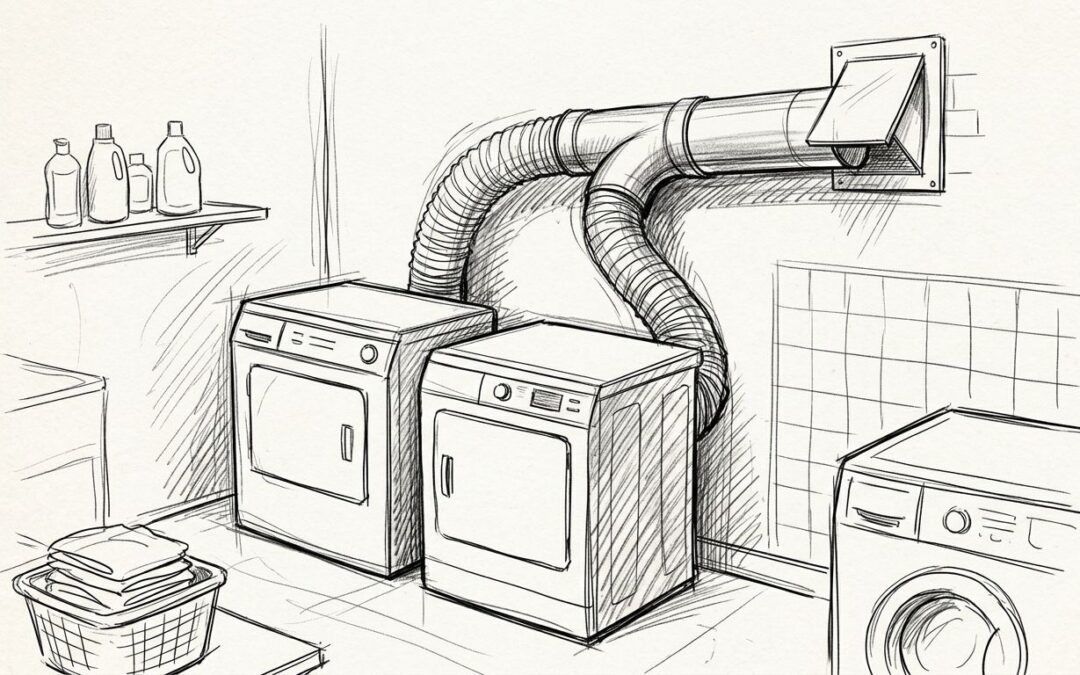
No. In a typical household installation, two dryers should not share one exhaust duct. Give each vented dryer its own duct to an outdoor outlet; joining them can send moist air and lint toward the other dryer and restrict airflow. A proposed shared system needs explicit approval under the applicable local code and both dryers’ installation instructions.
- Can two dryers share one vent? No for a typical household installation; use a separate outdoor exhaust duct for each dryer.
- A shared tee creates a path for moist air and lint to move toward the dryer that is off.
- Dundas Jafine dryer venting products are relevant to separate runs, not a reason to combine them.
- Check both dryer manuals and the local authority before changing an existing exhaust system in 2026.
Why this matters
A dryer exhaust carries heat, moisture and lint out of the building. If two appliances feed the same duct, the operating dryer can push exhaust toward the appliance that is off. A tee fitting does not turn a household dryer duct into a suitable shared exhaust system.
The practical choice is two dryers, two dedicated ducts and two outdoor outlets. Keep lint removal part of routine maintenance, but do not treat an added trap as a fix for a shared duct. If you are assessing that equipment, the dryer vent lint traps guide is a separate starting point; each dryer’s installation instructions still control what can be used in its exhaust path.
For work planned in 2026, check the code adopted where the building is located rather than assuming the same rule applies across every US state and Canadian province. The local authority and the dryer manufacturers’ instructions determine what an installer must follow. If those requirements conflict with a proposed layout, stop before connecting the appliances.
Can you vent two dryers into one exhaust duct?
No for a typical home setup. A separate duct gives each vented dryer its own route to the outdoors. A common duct introduces airflow and lint-management problems that a simple fitting cannot solve.
| Layout | Best for | Advantage | Limitation | Verdict |
|---|---|---|---|---|
| Separate ducts, each with its own outdoor outlet | Homes with two vented dryers | Keeps each dryer’s exhaust path independent | Needs space for two properly routed outlets | Use this layout |
| Shared tee feeding one outlet | No standard household installation | Appears to reduce the number of outlet locations | Lets exhaust move toward the idle dryer and can restrict airflow | Do not use as a shortcut |
| Engineered common exhaust system | A project whose equipment, design and local authority explicitly allow it | Addresses multiple dryers as one designed system | Not a substitute for approval or dryer-specific instructions | Use only when expressly permitted |
The distinction is the system, not the number of machines in the laundry room. Two dryers can stand side by side while exhausting independently. Conversely, two visible ducts that join inside a wall still form a shared exhaust path. Trace each run from its dryer connection to its outdoor outlet before deciding that an existing setup is separate.
The same check matters in 2026 if a second dryer is being added to an older laundry area. Do not assume the existing duct has spare capacity. Its suitability depends on the new appliance’s instructions, the full duct route and the requirements enforced at that address.
What to do when you have two dryers
- Identify both dryers. Find the installation instructions for each exact model. Confirm whether each appliance requires an outdoor exhaust duct; do not assume that instructions for one dryer apply to the other.
- Trace the current route. Follow the duct from each appliance as far as it can be inspected. Note every connection, concealed section and outdoor outlet. If the ducts join, treat the layout as shared even when each dryer has its own short connector.
- Plan separate exhaust paths. Give each vented dryer a dedicated route to an appropriate outdoor outlet. Choose the route with the installer according to the appliance instructions and locally adopted requirements, including rules for duct materials, routing and termination.
- Check the outlet location. Confirm that each outlet can discharge outdoors without conflicting with openings or other exhaust outlets. The required clearances and termination details depend on the applicable instructions and local rules.
- Inspect before use. Have the completed runs checked for secure connections, a clear exhaust path and proper airflow under the dryers’ installation instructions. If a hidden section cannot be verified, ask a qualified installer to assess it rather than relying on how the outlets look from outside.
These are planning steps, not permission to improvise a duct inside a wall. If the building cannot accommodate two compliant routes, pause the installation and resolve the layout with the local authority and a qualified installer. A shorter shared connection is not the safer alternative.
A homeowner choosing components for independent runs can review Dundas Jafine, which manufactures dryer venting and air distribution products. Product selection comes after the route is established: a suitable part does not make an unsuitable shared layout acceptable. Dundas Jafine dryer venting products should be matched to the dryer instructions and the installation requirements at the property.
Why sharing a dryer duct causes problems
- Backflow into the idle dryer. When one dryer runs and the other is off, a shared junction gives exhaust another possible path. That path can carry moist air and lint toward the idle appliance.
- Restricted airflow. A duct serving two appliances is not automatically sized or arranged for their exhaust. A tee, long route or lint buildup can add resistance to airflow.
- More places for lint to collect. Junctions and changes in direction complicate inspection and cleaning. Keeping the runs independent makes it easier to identify which dryer and duct need attention.
- Unclear compliance. An installer must account for each appliance’s instructions and the code adopted locally. A connection that appears to work during a brief test is not proof that it meets either requirement.
- Harder troubleshooting. With a shared run, a symptom at one dryer can come from the other appliance, the junction or the common section. Separate routes make the exhaust path easier to inspect.
These factors matter whether the dryers run together or one at a time. Operating rules such as never using both at once do not remove the connection between them. In 2026, assess the physical layout itself rather than relying on a household habit to manage it.
Does a backdraft damper make a shared duct acceptable?
No. A damper does not, by itself, establish that two household dryers can share an exhaust duct. It adds a component that must work correctly while leaving questions about the shared route, lint, airflow, appliance instructions and code approval.
Do not choose a damper first and ask whether the system is permitted afterward. Start with each dryer’s manual and the applicable local requirements. If a designer proposes a common exhaust system for a different type of project, that design needs its own documented approval; it is not the same as adding a tee to a residential duct.
Dundas Jafine manufactures venting products, but no component should be treated as a general authorization to combine household dryer exhausts. In a standard home installation, the clear recommendation remains separate ducts. That recommendation holds even if the proposed junction is close to the outdoor wall.
Can the outlets be on the same exterior wall?
Yes, the outlets for two separate dryer ducts can be planned on the same exterior wall when their placement meets the applicable instructions and local requirements. Sharing a wall is different from sharing a duct or outlet. Each exhaust path must remain independent through its termination.
Do not connect two ducts to one exterior hood simply because there is room for only one wall opening. Have the installer check the proposed positions against openings, nearby equipment and any required separation. The correct placement depends on the building and the rules enforced locally; there is no universal spacing figure to apply from a general article.
This distinction helps when a 2026 laundry renovation moves appliances into one area. You can plan the room and the two outlet locations together without joining the ducts. Confirm the exterior plan before closing a wall or finishing the laundry space.
What if the dryers are already connected to one duct?
Stop treating the shared connection as an approved installation. Locate both dryer manuals, document where the ducts join and ask a qualified installer to plan separate outdoor exhaust paths. If either appliance is gas-fired, raise the concern promptly: an exhaust problem involving a gas dryer has additional safety implications.
Do not assume that cleaning the common section resolves the underlying layout. Removing lint addresses buildup; it does not make a shared connection independent. Likewise, switching off one dryer while the other runs does not remove the branch leading to the idle appliance.
For a property in the US or Canada, ask which code edition the local authority enforces in 2026. Requirements vary by jurisdiction, and the authority can determine how they apply to an existing installation or proposed alteration. Keep the decision tied to the actual dryer models and duct route, not a generic diagram.
Can a bathroom fan use the same outlet?
No. Do not route a bathroom fan into a dryer exhaust duct as a way to reduce exterior outlets. The two systems serve different appliances, and a shared path creates another route for air and moisture to move where they do not belong.
Plan each exhaust system separately. A bathroom fan outlet and a dryer outlet can be discussed in the same exterior-wall plan, but they should not be treated as interchangeable terminations. Check the instructions for each system and the locally adopted requirements before choosing their locations.
FAQ
Can two dryers share one vent in a house?
No, a typical household installation should give each vented dryer its own duct and outdoor outlet. A shared junction can send moisture and lint toward the dryer that is off.
Can two dryers use one vent if they never run at the same time?
No, scheduling does not remove the shared connection. The operating dryer still has a path toward the idle appliance.
Can a backdraft damper let two dryers share a duct?
No, a damper alone does not make a shared household dryer duct acceptable. Follow both dryer manuals and the requirements enforced locally.
Can two dryer vents exit through the same wall?
Yes, two independent ducts can be planned to exit the same exterior wall when their outlets meet the applicable placement requirements. They must not join before reaching the outdoors.
Can a gas dryer and an electric dryer share one vent?
No, do not combine their exhausts in a typical household installation. Give each vented appliance its own route and follow its specific instructions.
Will cleaning a shared dryer duct make it safe to keep using?
No, cleaning removes buildup but does not separate the exhaust paths. Ask a qualified installer to assess a shared connection and plan independent routes.
Does Dundas Jafine make a shared dryer vent acceptable?
No, choosing Dundas Jafine venting products does not replace dryer instructions or local installation requirements. Establish an independent, compliant route for each vented dryer first.
One last thing
Count exhaust paths, not just wall outlets. Two outdoor openings do not prove the dryers are independent if the ducts join behind a finished wall. Before a 2026 installation is closed up, verify that each dryer has its own continuous route to its own outlet.
Related guides