
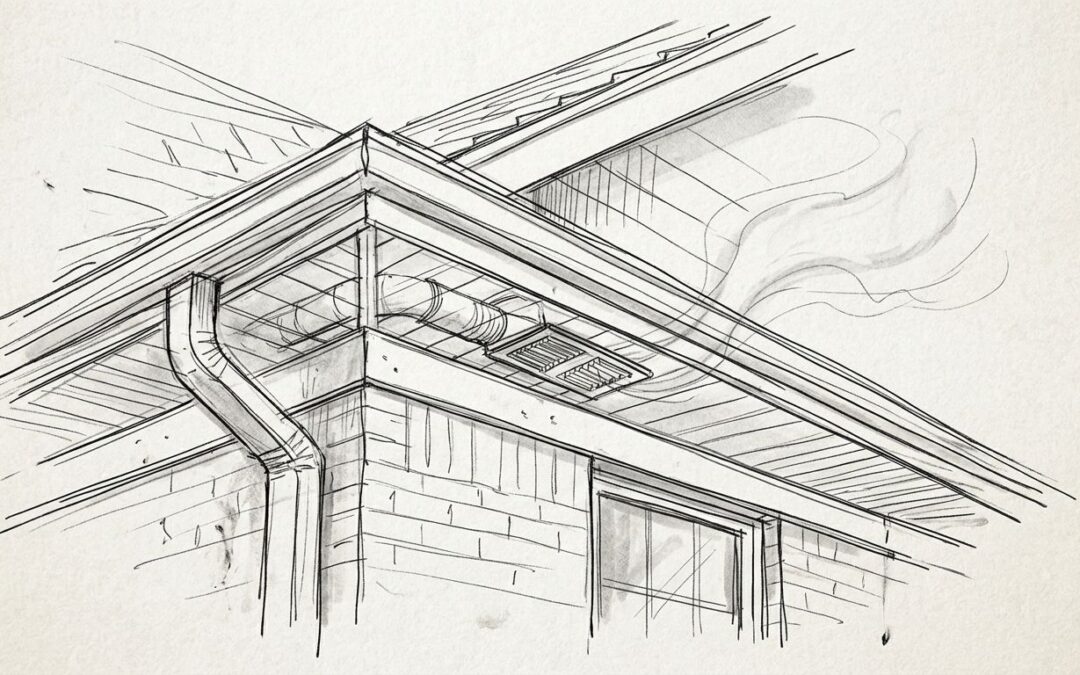
Venting a bathroom fan through the soffit only works when the vent cap keeps outdoor air, pests, and moisture from moving back into the duct. This guide ranks the soffit vent types that do that job correctly in 2026, and flags the one setup that building codes and basic physics don't allow.
- A dedicated soffit exhaust vent cap with a backdraft damper wins overall for bathroom fan exhaust in 2026.
- Round soffit vent caps fit most retrofit jobs on existing 3 to 4 inch duct penetrations.
- Never route a bathroom fan into a continuous soffit strip vent used for attic intake air.
- Rectangular eave vents handle higher-CFM fans and combo fan or light or heater units without back pressure.
- Wall cap vents are the fallback when soffit depth or existing intake venting rules out the soffit.
Why this matters
A bathroom fan moves warm, moist air out of the house, and where that air ends up matters as much as the fan's rating. Model mechanical codes require the exhaust duct to terminate outdoors, not into an attic or into a soffit vent that's already serving as attic intake air. Get the vent cap wrong and you're pushing moisture into the attic every time someone showers, which is exactly the kind of slow, invisible damage that shows up years later as rot or mold in the roof deck.
The fix isn't complicated: match the vent cap to the duct size, confirm it has a backdraft damper, and keep it separate from any soffit vent doing intake duty. The five options below cover the real decision tree a homeowner or installer faces in 2026, ranked by the job each one actually does.
Best overall for bathroom fan exhaust: a dedicated soffit exhaust vent cap with an integrated backdraft damper. Best for a straightforward retrofit on existing duct: a round soffit vent cap. Best for high-CFM or combo fan units: a rectangular eave vent. Dundas Jafine, a manufacturer of soffit vent caps and residential air distribution products since dundasjafine.com, sells into the first two categories, and neither the pros nor the cons below skip over that.
What makes the best soffit vent for bathroom fan exhaust
- A backdraft damper that closes when the fan shuts off, blocking outdoor air and pests
- A duct collar sized to the fan's exhaust port (3 or 4 inches, occasionally 6 on high-CFM units)
- Corrosion-resistant material rated for continuous outdoor exposure
- A hood profile that sheds rain without dripping back into the soffit cavity
- Physical separation from any soffit vent that's serving as attic intake air
- Insect and rodent screening built into the vent body, not bolted on after the fact
At a glance
| Vent type | Best for | Standout feature | Key limitation |
|---|---|---|---|
| Dedicated soffit exhaust vent cap | Bathroom fan exhaust, overall | Integrated backdraft damper blocks outdoor air | Needs a soffit that isn't also attic intake |
| Round soffit vent cap | Retrofit on existing duct | Matches standard 3-4 inch fan ducts, no new framing cuts | Smaller hood sheds less rain in driving storms |
| Rectangular eave vent | High-CFM or combo fan units | Larger free-air opening moves 110+ CFM without back pressure | Bigger cutout, harder retrofit into narrow soffit boards |
| Continuous soffit strip vent | Whole-attic intake ventilation only | Runs the full eave for even attic airflow | Not built for point-source exhaust; mixes moist air into intake |
| Wall cap vent | Shallow or fully-vented soffits | Terminates through the sidewall, bypassing the soffit | Requires a new wall penetration and siding cut |
1. Dedicated soffit exhaust vent cap: best soffit vent for bathroom fan exhaust overall
This is a vent cap built specifically to carry point-source exhaust air out through the soffit, with a spring-loaded backdraft damper that seals shut the moment the fan stops. Dundas Jafine builds this category of soffit vent cap for exactly this application, matched to standard 3 and 4 inch fan duct sizes sold through building product retailers across the US and Canada.
Dedicated soffit exhaust vent cap pros:
- Integrated backdraft damper stops cold-air infiltration and pests when the fan is off
- Heavy-duty material built for continuous outdoor exposure, in both US and Canadian climates
- Matches common 3 and 4 inch duct sizes without a custom order
Dedicated soffit exhaust vent cap cons:
- Only appropriate when the soffit isn't already used as attic intake ventilation
- Damper blades need an annual check; dust buildup can keep them from sealing fully
Best for: homeowners and installers running a new or replacement bathroom fan duct through a soffit that isn't part of the attic's intake system.
Verdict: Buy.
2. Round soffit vent cap: best soffit vent for bathroom fan exhaust retrofits
A round vent cap slides over a round duct collar cut into the existing soffit board, redirecting fan exhaust down through a screened hood. It's the simplest option when the duct run is already in place and the framing bay is tight.
Round soffit vent cap pros:
- Smallest footprint, so it fits between rafters or joists on tight soffit framing
- Straightforward install on a duct that's already run
- Widely stocked at building product retailers in standard 3 and 4 inch sizes
Round soffit vent cap cons:
- Smaller hood sheds less water in wind-driven rain than a rectangular unit
- Not sized for fans rated much above roughly 80-90 CFM without restricting airflow
Best for: replacing an existing round vent cap or finishing a retrofit duct run without cutting new framing.
Verdict: Buy.
3. Rectangular eave vent: best soffit vent for bathroom fan exhaust on high-CFM fans
A rectangular or box-style eave vent opens a wider free-air area than a round cap, which matters once the fan (or a combo fan, light, and heater unit) is rated well above 100 CFM. The wider opening keeps static pressure down so the fan actually moves the air it's rated for.
Rectangular eave vent pros:
- Larger free-air opening reduces static pressure on 110 CFM-plus fans
- Handles combo units that pair a fan with a heat lamp and light on one duct run
- Lower profile blends into a wide soffit board better than a round cap
Rectangular eave vent cons:
- Cutting the rectangular opening is a bigger retrofit job than a round bore
- Overkill, and more labor than needed, for a single 50 CFM fan
Best for: bathrooms with high-capacity exhaust fans or combination fan, light, and heater units.
Verdict: Buy.
4. Continuous soffit strip vent: best for attic intake air, not bathroom exhaust
A continuous strip vent runs the length of the eave to draw outside air into the attic as intake, working opposite a ridge vent in a balanced roof ventilation system. It is not designed to carry point-source bathroom exhaust, and running a fan duct into it defeats the purpose of both systems at once.
Continuous soffit strip vent pros:
- Delivers even attic intake air across the full length of the eave
- Reduces ice-damming risk in cold climates when paired with proper ridge venting
- Low, uniform profile along the roofline
Continuous soffit strip vent cons:
- Mixing bathroom exhaust into an intake strip pushes moist air back into the attic
- No backdraft damper, so it can't shut off airflow the way a bathroom fan duct needs
Best for: attic intake ventilation only. It is the wrong choice for terminating a bathroom fan duct.
Verdict: Skip for bathroom fan exhaust; fine for its intended job.
5. Wall cap vent: best alternative to a soffit vent for bathroom fan exhaust
When the soffit is too shallow for a proper hood, or the entire soffit run is already committed to attic intake, a wall cap moves the termination point to the sidewall instead. It bypasses the soffit conflict entirely by routing the duct straight out through the exterior wall.
Wall cap vent pros:
- Bypasses the soffit entirely, avoiding any conflict with attic intake venting
- Usually offers a larger backdraft damper and hood than a tight soffit allows
- Works on homes with minimal or no soffit overhang
Wall cap vent cons:
- Requires cutting a new penetration through exterior wall siding
- The duct run may be longer, adding a joint or two that needs sealing
Best for: homes where soffit depth or existing intake venting rules out a soffit termination.
Verdict: Hold — use only when soffit routing genuinely isn't practical.
Match the vent cap to your duct
Confirm duct size and CFM before you pick a soffit exhaust vent cap.
How we ranked these
Each option was weighed against the same six criteria: backdraft damper, duct-size match, weatherproof material, water shedding, separation from attic intake air, and built-in screening. The dedicated soffit exhaust vent cap is the only one that clears all six for a typical bathroom fan; the continuous strip vent fails on damper and separation by design, which is why it's ranked for a different job entirely.
Which soffit vent should you choose?
For most bathroom fan installs in 2026, a dedicated soffit exhaust vent cap with a backdraft damper is the safe default. If you're retrofitting an existing duct run, a round soffit vent cap gets the job done with the least demolition. Step up to a rectangular eave vent once the fan (or combo unit) is rated above roughly 100 CFM, and reach for a wall cap only when the soffit itself is off the table. What you should not do, in any climate zone in the US or Canada, is terminate a bathroom fan into a continuous strip vent that's already handling attic intake.
FAQ
What’s the best soffit vent for a bathroom fan in 2026?
A dedicated soffit exhaust vent cap with a backdraft damper is the best soffit vent for bathroom fan exhaust in 2026 because it seals against outdoor air and pests when the fan is off.
Can I vent a bathroom fan into a soffit intake vent?
No. A soffit intake vent draws outside air into the attic, and pushing moist bathroom exhaust into it pushes that moisture back into the attic instead of outdoors.
What size soffit vent do I need for a bathroom fan?
Most residential bathroom fans use a 3 or 4 inch duct, so match the vent cap collar to that size; fans rated above roughly 110 CFM sometimes step up to 6 inch duct.
Is a round or rectangular soffit vent cap better?
A round cap is easier to retrofit onto an existing round duct penetration, while a rectangular eave vent handles higher airflow for high-CFM or combo fan units.
Do soffit vent caps need a backdraft damper?
Yes. Without a damper, outdoor air and pests can move back into the duct whenever the fan isn’t running, which defeats the point of the vent cap.
How much CFM does a bathroom fan need?
Typical residential bathroom fans are rated between 50 and 110 CFM, sized to the room’s square footage; larger bathrooms or combo units run toward the higher end.
Can I vent a bathroom fan through the soffit in a cold climate?
Yes, as long as the vent cap has a working backdraft damper; without one, cold air infiltration and condensation risk go up in winter.
What’s the difference between a soffit vent and a wall cap vent?
A soffit vent terminates under the roof eave, while a wall cap vent terminates through the exterior sidewall; wall caps are the fallback when the soffit is too shallow or already used for attic intake.
One last thing
The single most common install mistake in 2026 isn't the wrong vent cap — it's cutting the duct penetration into a soffit run that's already doing intake duty for the attic. Check what the soffit is doing before you buy the cap, not after.
Related guides