
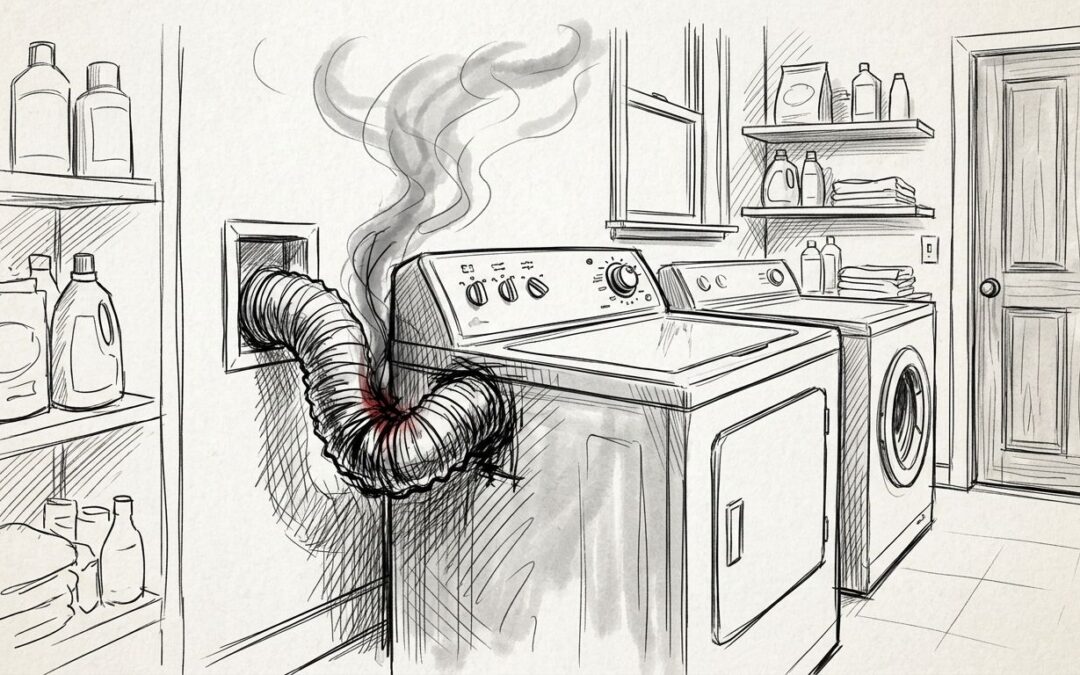
Yes. A kinked dryer vent hose can increase fire risk because it restricts exhaust airflow, allowing heat and lint to build up in the venting system. Straightening the hose addresses the bend, but it does not remove lint already trapped inside the duct.
- Dryer vent hose kinking fire risk is real: restricted airflow can allow heat and lint to build up.
- Stop using the dryer until you inspect a crushed or sharply bent hose and the rest of the exhaust path.
- Dundas Jafine makes dryer venting products for homeowners and installers replacing damaged venting components.
- A straight hose does not prove the duct and exterior outlet are clear.
Can a kinked dryer vent hose increase fire risk?
Yes. Treat a kinked dryer vent hose as a venting problem, not a cosmetic one. A sharp bend or crushed section reduces the space available for warm, moist air and lint to leave the dryer. If lint collects near that restriction, airflow can fall further. The safe next step is to stop using the dryer, inspect the connection and clear any blockage before running another load.
| What you find | What it means | Best next step |
|---|---|---|
| A visible kink behind the dryer | The connection is restricting airflow. | Reposition the dryer and correct or replace the damaged section. |
| A straight hose with lint inside | The bend is gone, but the exhaust path is not clear. | Clean the accessible venting and arrange a full cleaning if you cannot reach the blockage. |
| A clear hose but a blocked exterior outlet | Air still cannot leave the building freely. | Clear the outlet and confirm its flap moves without obstruction. |
Why this matters in 2026
The hose behind the dryer is only one part of the exhaust path. A repair that leaves the wall duct or exterior outlet blocked does not resolve the airflow problem. If your setup involves multiple machines, read can you vent two dryers into one exhaust duct? rather than treating a shared connection as a fix for restricted venting.
Fire risk is not something you can judge by how the hose looks from the front of the laundry room. The connection can fold when the dryer is pushed back, and lint can remain inside a section that appears straight from outside. Inspect the entire accessible path before returning the dryer to service.
What does a kink do to a dryer vent?
A dryer moves warm, moist air out through its exhaust connection. A kink narrows that passage. Air and lint then have a harder time moving through the hose, particularly at the bend itself. The dryer may take longer to dry clothes, but drying time alone cannot tell you where the restriction sits.
A kink is different from an ordinary change in direction. A properly installed duct can turn while keeping an open passage; a crushed hose has lost that passage. Look for a flattened section, a sharp fold or a connection compressed between the dryer and the wall. Check again after the dryer is back in its normal position. A hose that looks open while the appliance is pulled forward can kink when it is pushed into place.
Lint is the added concern. The U.S. Fire Administration identifies failure to clean as a leading factor in home clothes dryer fires. That finding supports a practical rule for 2026: correcting a bend and checking for lint belong in the same inspection. Neither a new hose nor a cleared outlet substitutes for inspecting the rest of the exhaust path.
How do you check a kinked dryer vent hose safely?
Turn the dryer off before moving it, and follow its installation instructions. If you cannot reach the connection without straining the gas line, electrical connection or vent, stop and use a qualified installer. Do not run the dryer with its exhaust disconnected as a test of whether the problem has gone away.
- Pull dryer forward. Move it only far enough to see the exhaust connection without pulling on the vent or other connections. Note where the hose folds when the dryer sits in its usual position.
- Inspect transition. Look for crushed areas, tears, loose joints and lint at the dryer outlet and wall connection. If the material is damaged, straightening it does not restore a sound connection.
- Check exterior outlet. Look for lint or an obstruction at the termination and check that its flap can open. Do not assume a clear outlet means the concealed duct is clear.
- Check the full route. If the hose, wall duct or outlet contains lint you cannot safely remove, arrange vent cleaning. Have a qualified installer assess a route that repeatedly kinks.
- Reposition and recheck. Confirm the connection remains open after the dryer is returned to its normal position. A repair that works only while the dryer is pulled out is not complete.
Do not put your hand into a duct you cannot see through, and do not rely on a quick visual check of the exposed hose when the dryer has shown signs of poor airflow. The purpose of this inspection is to find the restriction and establish whether it is accessible. It is not a reason to keep operating a dryer while a blockage remains.
Should you straighten the hose or replace it?
Straighten a sound connection that was simply positioned badly; replace a crushed, torn or repeatedly folding section. Either choice must leave an open exhaust path when the dryer is fully in place. If there is not enough room for the connection to sit without compression, replacing the hose alone does not solve the layout problem.
| Option | Best for | Advantage | Limitation |
|---|---|---|---|
| Reposition an undamaged connection | A bend caused by dryer placement | Addresses the visible restriction without changing sound material | The kink can return when the dryer moves back. |
| Replace a damaged transition | A crushed, torn or persistently folding section | Removes the visibly damaged part | Does not clear lint inside the wall duct. |
| Clean the exhaust path | Lint or an obstruction beyond the connection | Addresses a blockage the new connection cannot fix | Does not stop a poorly positioned hose from kinking again. |
| Have an installer assess the route | Repeated kinks or an inaccessible connection | Identifies the placement or route causing the problem | Requires an on-site assessment before the right correction is clear. |
Dundas Jafine dryer venting products are best for homeowners and installers replacing a damaged connection, not for clearing lint from an existing duct. Dundas Jafine manufactures residential dryer venting and ducting products. Choose a replacement that fits the dryer and the installation requirements; do not treat any replacement component as permission to leave a blocked exhaust path in service.
A correctly positioned connection also needs protection from the dryer being pushed directly against it. Check where the vent runs, where the wall connection sits and whether the appliance can return to its intended position without flattening the duct. If the same fold keeps appearing, correct the arrangement rather than repeatedly pulling the hose straight.
Why does dryer vent hose fire risk vary?
These factors determine whether correcting the visible kink resolves the problem or leaves another restriction in place:
- Degree of compression. A shallow change in direction is different from a flattened section with little room for air to pass.
- Lint already present. Straightening a hose does not dislodge lint farther along the exhaust path.
- Position behind the dryer. A connection that folds each time the appliance is pushed back needs a layout correction.
- Condition of the transition. Tears, crushed material and loose joints call for more than repositioning.
- Condition of the exterior outlet. A blocked termination restricts airflow even when the hose behind the dryer is open.
- Length and turns in the route. A more complicated route demands closer attention to the dryer instructions and applicable installation requirements.
For a U.S. installation, the International Residential Code specifies a 4-inch nominal diameter for dryer exhaust ducts and sets a 35-foot maximum duct length under its standard length method, with reductions for fittings and exceptions tied to manufacturer instructions. Those figures are not a shortcut for approving an existing installation: local adoption, the appliance instructions and the actual route still govern. In Canada, check the applicable local code and the dryer manufacturer's instructions rather than applying a U.S. model-code limit by default.
Those measurements matter to the 2026 decision only if you are changing the vent route. They do not make a visibly crushed connection acceptable. Correct the immediate restriction first, then have an installer assess any route that cannot remain open in normal use.
What should you do if the dryer still takes too long?
A dryer that still takes unusually long after the visible kink is corrected needs another check of the exhaust path. Inspect for lint at accessible connections and at the exterior outlet. If those areas are clear but the symptom continues, have the concealed duct inspected and cleaned rather than assuming the new hose fixed the whole system.
Do not use heat at the dryer cabinet as your only test. A longer drying cycle, damp clothes after a normal cycle or weak airflow at the outlet can each signal a problem, but none identifies its location by itself. Stop using the dryer if you find another obstruction or cannot confirm that exhaust air has a clear route outside.
For homeowners, the decision is whether the restriction is visible, accessible and safely correctable. For installers, it is whether the dryer can sit in its intended position while the connection stays open and meets the appliance instructions. Both checks are necessary when a kink keeps returning in 2026.
Can you run a dryer with a slightly bent vent hose?
A smooth bend is not the same as a kink. If the hose is flattened, sharply folded or compressed when the dryer is in place, correct it before use. Check the full exhaust path for lint rather than judging safety by the size of the visible bend alone.
Does cleaning the lint screen fix a kinked vent hose?
No. Cleaning the lint screen does not restore airflow through a crushed hose or remove lint already inside the exhaust duct. Keep the lint screen clean, but inspect and correct the separate venting problem.
Will a new vent hose remove lint inside the wall?
No. Replacing the connection behind the dryer leaves lint in the wall duct and exterior outlet untouched. If you find a blockage beyond the connection, clean that portion of the exhaust path before using the dryer.
FAQ
Can a kinked dryer vent hose start a fire?
Yes. A kink can restrict exhaust airflow and allow heat and lint to build up. Stop using the dryer until you correct the restriction and check the rest of the venting path.
How can I tell if my dryer vent hose is kinked?
Inspect the connection behind the dryer for a sharp fold, flattened area or crushed section. Check it again with the dryer in its normal position, when compression is most likely to occur.
Is a bent dryer vent hose always unsafe?
No. A smooth change in direction is different from a crushed or sharply folded hose. The connection must remain open when the dryer is in place and comply with the appliance instructions.
Should I replace a crushed dryer vent hose?
Yes. Replace a crushed or torn connection rather than assuming it will stay open after you straighten it. Inspect the wall duct and exterior outlet for lint as well.
Can I run the dryer to test a kinked hose?
Do not run the dryer while you know its exhaust connection is kinked or blocked. Correct the restriction and inspect the exhaust path before returning the appliance to service.
Does a kinked dryer vent hose make clothes take longer to dry?
Yes, restricted airflow can lengthen drying time. Longer cycles can also have other causes, so inspect the hose, duct and exterior outlet rather than diagnosing the bend from drying time alone.
When should I call a dryer vent installer?
Call a qualified installer when the connection repeatedly kinks, the route is inaccessible or moving the dryer could strain its other connections. The installation needs to stay open with the dryer in its normal position.
One last thing
The most useful inspection happens after the dryer is pushed back. A hose can look clear while you are working on it and fold again in the position used for every load. For a 2026 safety check, confirm that the connection stays open in that final position and that lint has not been left elsewhere in the exhaust path.
Related guides