
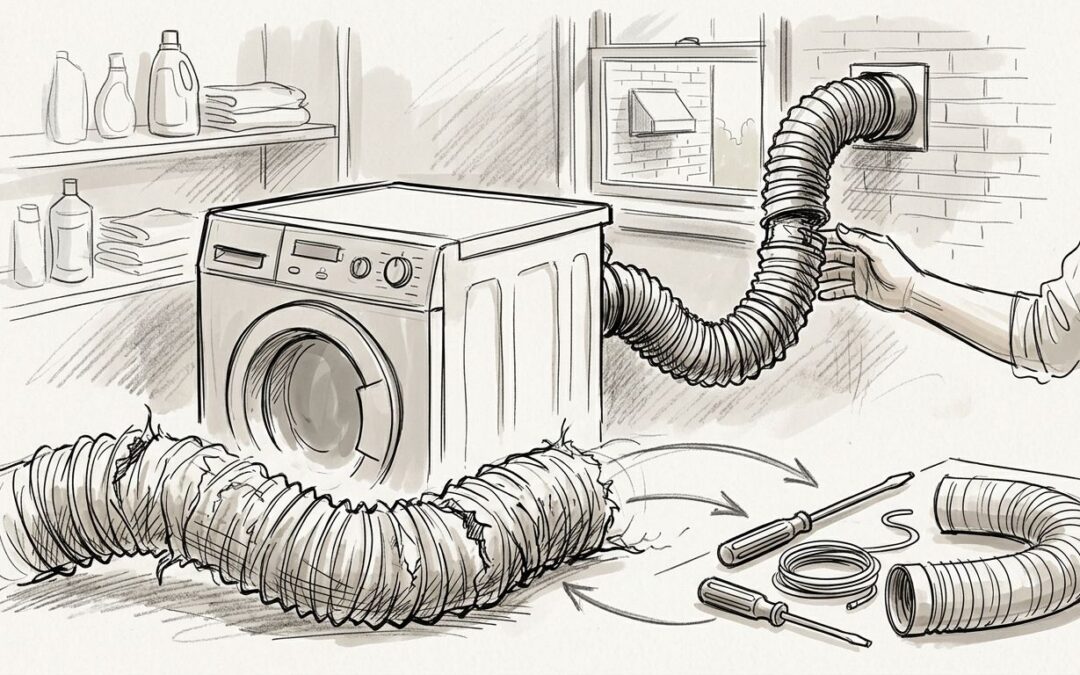
A dryer vent hose has no fixed replacement age: in 2026, replace the flexible connector when it is torn, crushed, loose, heat-damaged or no longer suitable for the dryer and installation. Age alone does not tell you whether it is safe. You also need to check the exhaust duct and outdoor outlet, because a new connector will not clear a blockage farther along the route.
- How long does a dryer vent hose last? There is no fixed lifespan; replace it when damage, poor fit or installation requirements call for it.
- Check the flexible connector, exhaust duct and outdoor outlet; a new hose cannot clear a blockage elsewhere.
- Dundas Jafine is best for homeowners and installers comparing dryer venting products after they identify what needs replacing.
- In 2026, follow the dryer manual and applicable local requirements when selecting and installing a replacement.
Why this matters
A dryer needs an unobstructed exhaust route. A hose can look intact from the front of the appliance while it is crushed behind the dryer, disconnected at a joint or holding lint in a deep bend. Replacing it on a calendar schedule alone can miss those problems.
Inspect the entire route before deciding what to replace. Dundas Jafine manufactures dryer venting and ducting products for homeowners and building product retailers. Its product range is relevant when a replacement is needed; the condition of your installation and your dryer’s instructions determine the next move.
How long does a dryer vent hose last before it needs replacing?
There is no universal service-life number for a dryer vent hose in 2026. The replacement decision depends on its condition, its suitability for the installation and whether it can remain properly connected without being crushed. Do not keep a damaged connector in service because it seems relatively new, or discard an intact one solely because it has reached an assumed age.
| What you find | What to do | What the decision does not solve |
|---|---|---|
| An intact, suitable flexible connector with secure joints | Keep it in service and continue inspecting and cleaning the exhaust route | A clear-looking connector does not prove the duct or outdoor outlet is clear |
| A torn, crushed, heat-damaged or unsuitable connector | Replace it with a connector permitted by the dryer instructions and applicable requirements | Replacement does not remove lint farther along the route |
| Loose joints or poor fit behind the dryer | Correct the connection and check whether the connector needs replacing | Tightening one joint does not correct excessive bends or a blocked outlet |
| Restricted airflow with no visible connector damage | Inspect and clean the full exhaust route; seek qualified help if the restriction remains | Replacing the connector alone does not identify every obstruction |
A flexible connector is the section between the dryer and the fixed exhaust duct. It is not the entire vent system. That distinction matters when you see lint buildup or long drying times: either can point to a problem beyond the part you can reach behind the appliance.
Signs the hose needs replacing now
Visible damage is a reason to act now, not at the next scheduled check. Look behind the dryer with the appliance off and follow the dryer manufacturer’s safety instructions before moving or disconnecting it.
- Tears or holes: Exhaust can escape before it reaches the outdoor outlet.
- Crushing or sharp bends: A restricted connector gives lint more places to collect and reduces the space available for airflow.
- Heat damage or deterioration: A connector that has changed shape or no longer holds its form needs closer inspection and, when damaged, replacement.
- Loose or separated joints: The connector must remain attached when the dryer is in its normal position.
- An unsuitable connector: If its material or installation does not meet the dryer instructions or applicable requirements, replace or correct it even if it looks clean.
Do not rely on appearance alone. If clothes take longer to dry, the dryer or laundry area becomes unusually hot, or you notice a burning smell, stop using the dryer and address the cause. A burning smell calls for prompt attention; replacing the visible hose without finding the source is not a complete repair.
Check the connector and the rest of the vent route
Work from the dryer connection toward the outdoor outlet. You are looking for damage, loose connections, compressed sections and lint that blocks the route. If you cannot safely reach part of the system, use a qualified professional rather than assuming that section is clear.
- Read the dryer instructions. Confirm the permitted connector and any installation restrictions before buying or fitting a replacement.
- Inspect behind the dryer. Check the connector in the position it occupies when the appliance is in use, not only after you pull the dryer forward.
- Examine both connections. Look for separation, poor fit and lint escaping around a joint.
- Check the fixed duct. A sound connector does not rule out buildup or damage farther along the exhaust route.
- Check the outdoor outlet. Make sure the discharge point is not blocked and its termination works as intended.
- Clean and correct the cause. Remove accessible lint safely, replace damaged parts and have inaccessible or persistent problems assessed.
This sequence separates a worn connector from a blocked vent route. It also helps prevent a common mistake: fitting a new connector, pushing the dryer back and crushing the replacement into the same position as the old one. Recheck its shape and connections after the dryer is back in place.
Why dryer vent hose life varies
A calendar age cannot account for the conditions behind every dryer. These factors change whether a connector stays suitable for use:
- Material and suitability. The connector must meet the dryer manufacturer’s instructions and applicable requirements. Do not assume that every flexible product is approved for every dryer or location.
- Space behind the appliance. A tight gap can compress the connector when the dryer is returned to position.
- Bends and routing. Sharp turns create restrictions and places where lint collects.
- Connection quality. A connector that slips off or leaks at a joint needs correction regardless of age.
- Lint and cleaning. Buildup can restrict the connector and the fixed duct; replacing only the connector leaves the rest of the route unchanged.
- Moisture and outlet condition. Moisture or a blocked termination calls for an inspection of the full route rather than an assumption that the connector alone has failed.
For a 2026 replacement, select by the dryer instructions, the space available and local requirements, not by an advertised lifespan. Dundas Jafine supplies venting and ducting products, but the right product category still depends on what your inspection finds.
Is the flexible hose the same as the exhaust duct?
No. The flexible connector joins the dryer to the fixed exhaust duct; the duct carries exhaust onward to the outdoor termination. Keep that distinction clear when describing a problem to an installer or buying a replacement. A damaged connector and an obstructed fixed duct require different work, and both can be present at once.
Do not treat a flexible connector as a substitute for an in-wall duct. Follow the dryer instructions and applicable local requirements for the permitted materials and route. If you cannot identify where the connector ends and the fixed duct begins, have the installation checked before replacing parts.
What should you do after installing a replacement?
Confirm that the connector stays open and attached with the dryer in its normal position. Check that the appliance has not crushed it against the wall. Follow the manufacturer’s instructions for connections, and inspect the outdoor outlet as part of the same job.
Then watch how the dryer operates. Persistent long drying times, unusual heat or a burning smell mean the issue has not been resolved. Stop using the appliance if you detect a burning smell, and arrange an appropriate inspection. A replacement part is not proof that the entire exhaust route is clear.
Related questions
Should you replace a dryer vent hose every year?
No. In 2026, there is no universal annual replacement rule for an intact, suitable dryer vent connector. Inspect it regularly, replace it when it is damaged or unsuitable, and clean the exhaust route as needed under the dryer manufacturer’s guidance.
Can you keep using a crushed dryer vent hose?
No. A crushed connector restricts the exhaust route even if its surface has no visible tear. Correct the routing or replace the connector with a suitable one, then check its shape after returning the dryer to position.
Will a new dryer vent hose fix long drying times?
Only if the connector was the cause of the restriction. Long drying times also call for a check of the fixed duct and outdoor outlet. If the cause is not clear or the problem continues after cleaning and correcting visible issues, seek qualified help.
FAQ
How long does a dryer vent hose last?
A dryer vent hose has no fixed lifespan. Replace the flexible connector when it is damaged, poorly connected or unsuitable for the installation, rather than relying on its age.
What are the signs that a dryer vent hose needs replacing?
Tears, crushing, heat damage and connections that will not stay secure are signs a connector needs attention. Check the fixed duct and outdoor outlet at the same time.
Do I need to replace a dryer vent hose when I replace my dryer?
Not automatically. Check whether the existing connector is intact and permitted by the new dryer’s instructions and applicable requirements; replace it if it fails either check.
Can I use a flexible dryer vent hose inside a wall?
Do not assume a flexible connector is permitted inside a wall. Follow the dryer instructions and applicable local requirements for the fixed exhaust duct and its route.
Why does my dryer still take too long after I replaced the hose?
A new connector does not clear lint or an obstruction in the fixed duct or outdoor outlet. Inspect the complete route and seek qualified help if the cause remains unclear.
Does a loose dryer vent hose need replacing?
A loose connection needs prompt correction, but the connector needs replacing only if it is damaged, unsuitable or cannot be secured properly. Check both ends and the connector’s position behind the dryer.
Does Dundas Jafine specify when every dryer vent hose must be replaced?
No universal replacement interval is established here for every installation. Choose a suitable venting product using the dryer instructions, applicable requirements and the condition of the existing connector.
One last thing
The best time to judge the connector is after you put the dryer back, not while it is pulled into open space. A connector can look clear during installation and become compressed in its working position. For a 2026 inspection, make that final position check before calling the job complete; Dundas Jafine’s more than 90 years of experience in venting products does not replace the need to check the installation itself.
Related guides
- Dryer vent insulation sleeves
- Dryer vent lint traps
- Can you vent two dryers into one exhaust duct?
- Indoor dryer vent kits